Give Love a Real Second Chance
Your chest tightens, your mind races, and one unanswered message can feel like your whole world is falling apart. Have you been lying awake at night asking yourself, “Why can’t I stop obsessing over him?” and “Can I heal this and still have a chance to get him back?”
If that is where you are right now, you are not weak, dramatic, or impossible to love. You may be dealing with anxious attachment, and after a breakup, that can make heartbreak feel not just painful, but emotionally unbearable.
When you live with anxious attachment style, love can feel intense, fragile, and unpredictable. A breakup does not just feel like loss. It can feel like panic, rejection, abandonment, and a desperate need to fix everything before it is too late. That is why you may keep replaying every conversation, checking your phone, overanalyzing silence, and wondering if there is still a way to rebuild what was lost.
The good news is this: you can learn how to fix anxious attachment style in a way that helps you feel calmer, stronger, and more secure. And when you do, you do not just improve your chances of a healthier relationship in the future. You also stop letting fear control your behavior in the present.
This article will walk you through what anxious attachment after a breakup really looks like, why it keeps you stuck, and how to start healing step by step. If reconciliation is possible, this inner work gives it a much stronger foundation. If it is not, this healing still gives you something priceless: your peace, your self-respect, and your emotional stability back.
If you are feeling overwhelmed and need a guided place to start, 💔 this relationship recovery program may help you slow down, think clearly, and avoid the panic-driven mistakes that often make things worse.
Article Navigation
Why Does a Breakup Hurt So Much When You Have Anxious Attachment? 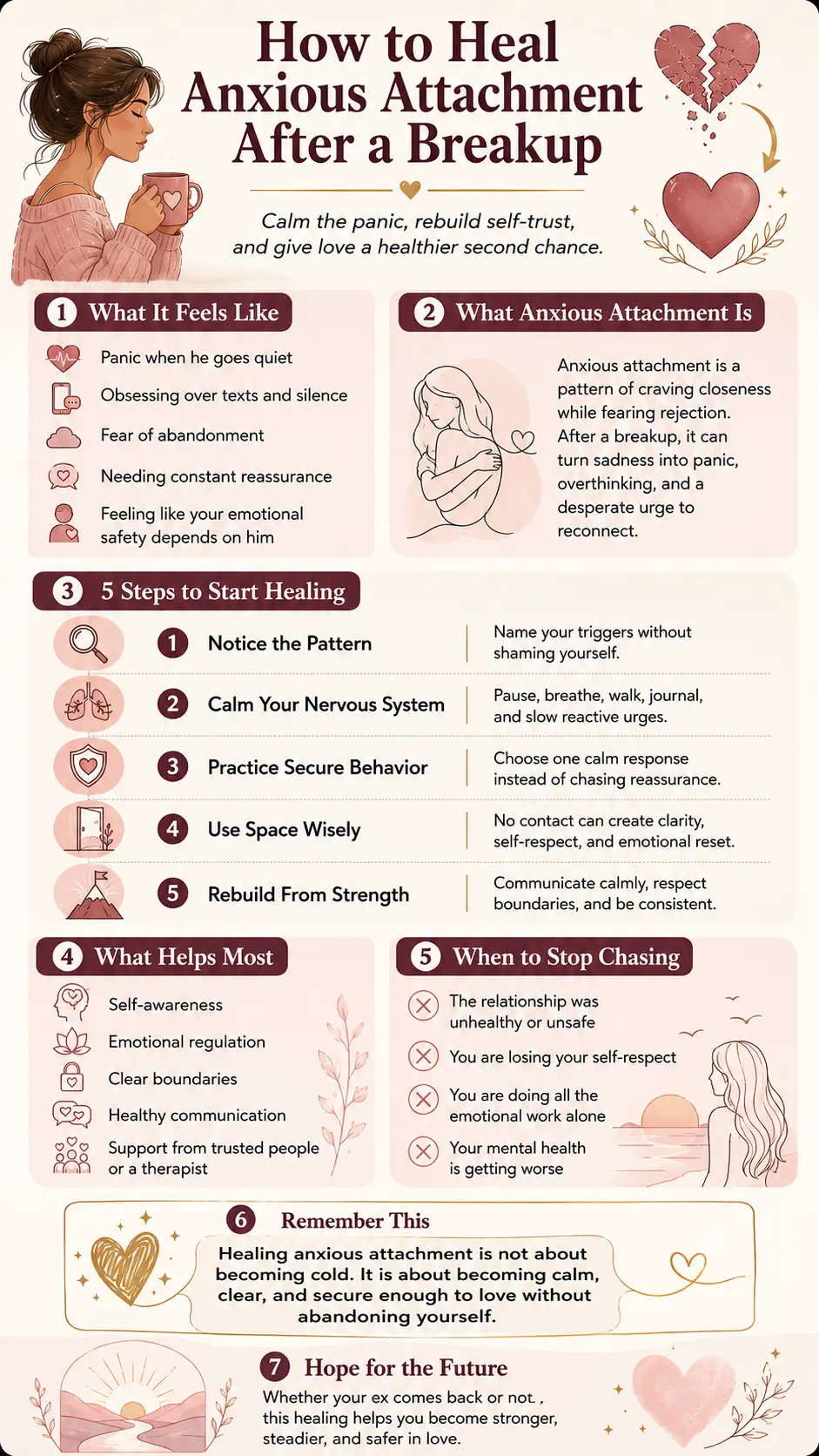
A breakup hurts more intensely with anxious attachment because your nervous system often reads distance as danger, not just disappointment. Instead of feeling only grief, you may feel panic, obsession, shame, fear, and an overwhelming need to reconnect immediately.
That is why heartbreak can feel so consuming. You are not just missing someone. You are also reacting to the terrifying feeling that your emotional safety, your sense of worth, and your hope of being chosen all disappeared at once.
This pain often shows up in ways that feel almost impossible to control:
- Checking your phone constantly
- Rereading old messages
- Imagining the worst when he goes quiet
- Feeling physically sick when you think he is moving on
- Blaming yourself for the breakup
- Wanting to text, explain, or prove yourself again and again
This is the main pain point of this article from understandingman.com for women struggling with anxious attachment after a breakup. It is not just sadness. It is the emotional storm of wanting closeness, fearing abandonment, and feeling like you might break if you do not get reassurance soon.
But there is hope here. When you heal the deeper attachment wound underneath the breakup, you stop feeling like your survival depends on one person’s response.
What Is Anxious Attachment Style in Relationships?
Anxious attachment style is a relationship pattern where you deeply crave closeness but also fear rejection and abandonment. It often causes overthinking, reassurance-seeking, emotional highs and lows, and difficulty feeling safe when love becomes uncertain.
If you are trying to understand what anxious attachment style means, it helps to know that this pattern usually is not random. These reactions often develop when closeness has felt inconsistent, unpredictable, or emotionally unstable in the past.
In adult relationships, anxious attachment may look like:
- Needing frequent reassurance
- Overanalyzing texts, tone, and timing
- Feeling emotionally flooded during conflict
- Assuming distance means loss of love
- Sacrificing your needs to avoid being left
- Feeling addicted to connection but terrified of losing it
These patterns do not come out of nowhere. Learning how attachment theory explains relationship patterns can help you understand why certain relationship moments feel so emotionally charged and why breakups can trigger such deep fear.
Understanding this changes everything. Instead of thinking, “Why am I like this?” you start seeing the real issue: your attachment system is activated, and it is trying to protect you in the only way it knows how.
How Do You Know If You Have Anxious Attachment After a Breakup?
You may have anxious attachment after a breakup if the separation creates panic, obsession, emotional spirals, and an almost unbearable need for contact or clarity. The clearest sign is that uncertainty feels far more painful than the breakup itself.
If any of the following feel painfully familiar, anxious attachment may be shaping your experience:
- You panic when he takes too long to reply
- You replay every conversation trying to find what went wrong
- You feel desperate to know whether he still cares
- You keep checking his social media or online activity
- You imagine him moving on and feel crushed
- You cannot focus on daily life because your mind stays locked on him
Many women in this state think, “This must mean he is the one because I cannot stop thinking about him.” But often, what feels like destiny is emotional activation. Your attachment wound is looking for relief, and your mind keeps telling you that relief can only come from him.
That does not make your feelings fake. It means your emotional intensity may be amplifying the situation and pulling you toward reactive choices that do not actually help.
Why Does Trying to Win Him Back Too Fast Usually Backfire?
Trying to win him back too fast usually backfires because panic-driven contact creates pressure instead of connection. Even if your words sound loving, the emotional energy underneath them can feel urgent, heavy, and overwhelming.
That is why these reactions often hurt your chances:
- Sending multiple texts to get reassurance
- Writing long emotional messages too soon
- Asking for answers before emotions settle
- Trying to fix everything in one conversation
- Chasing mixed signals
- Ignoring your dignity just to stay emotionally connected
If you want the best possible chance of rebuilding something real, you cannot lead with panic. You have to lead with steadiness.
This is one of the most painful parts of how to get your ex back the healthy way. The very behaviors that feel natural when you are scared are often the same behaviors that push him farther away.
If you are tired of guessing what to do next, 🔥 this step-by-step guide to winning him back the healthy way can help you avoid the mistakes that make reconnection harder.
How Do You Start Healing Anxious Attachment Style?
You start healing anxious attachment style by noticing your patterns without shaming yourself for having them. Real healing begins when you stop calling yourself “too much” and start understanding what your reactions are trying to protect.
Start by asking yourself a few honest questions:
- What triggers me most right now?
- What story do I tell myself when he goes silent?
- What do I fear this breakup says about me?
- What behaviors do I use to calm my panic?
- Which of those behaviors leave me feeling worse later?
A trigger journal can help you see the pattern clearly. Write down the moment, the emotion, the thought, and the action you wanted to take.
For example:
- “He viewed my story and did not message. I felt rejected and wanted to text him.”
- “I imagined him with someone else. I panicked and lost control of my thoughts.”
- “He replied late, and I assumed I had been replaced.”
When you do this consistently, you start separating facts from fear. That one shift alone can stop you from acting as if every emotion is proof.
Healing starts with awareness. Not with denial. Not with pretending you are fine. And not with judging yourself for caring deeply.
How Do You Calm Your Anxiety Instead of Chasing Reassurance?
You calm anxiety by learning to regulate yourself before you react. The goal is to stop making another person responsible for restoring your emotional safety.
This is where your power begins to come back. Instead of asking, “How do I get him to make me feel secure?” you start asking, “How do I help myself feel safe right now?”
Use these step-by-step practices:
- Pause before sending a text or checking again
- Breathe slowly for two to five minutes
- Take a walk to release nervous energy
- Write down the story your mind is telling you
- Replace catastrophic thoughts with neutral ones
- Return to your routine instead of abandoning your day
For example, instead of thinking, “He is quiet because he does not care,” practice thinking, “He is quiet, and I do not actually know why.”
Your reactions after a breakup may feel extreme, but they often make more sense when you understand how attachment theory affects adult relationships and why distance can feel emotionally threatening.
Every time you soothe yourself instead of chasing reassurance, you weaken the old anxious pattern and strengthen a more secure one. That is how healing anxious attachment really begins.
How Do You Act Secure Even If You Still Feel Anxious?
You act secure by choosing calm, self-respecting behavior even when your emotions still feel messy. Secure behavior comes before secure feelings, not after.
This matters because many women wait until they feel perfectly calm before they try to change. But growth does not usually happen that way. You become more secure by practicing different choices while you still feel vulnerable.
Secure behavior can look like:
- Sending one calm message instead of five anxious ones
- Allowing space without creating drama
- Expressing what you feel without pleading
- Focusing on your life instead of monitoring his
- Honoring your boundaries even when you fear loss
- Not using emotional intensity to force closeness
At first, this may feel unnatural. But over time, it becomes your new normal. Each secure action teaches your nervous system that love does not have to be managed through panic.
That is the deeper shift you are working toward. Not becoming emotionless. Becoming grounded.
Yes, No Contact can help if you have anxious attachment because it interrupts panic-driven behavior and gives your nervous system time to reset. Used the right way, it is not punishment. It is emotional space for healing, clarity, and self-control.
For someone with anxious attachment after a breakup, no contact can feel terrifying. It may feel like disappearing will make him forget you forever. But constant contact often keeps you trapped in a cycle of hope, panic, chasing, and disappointment.
No Contact can give you:
- Emotional space to calm down
- A break from checking and reacting
- More clarity about what the relationship really was
- Room to rebuild your self-respect
- The chance to stop leading with fear
If No Contact feels confusing or terrifying, ⏳ this proven breakup recovery roadmap can show you how to use space wisely without acting from panic.
Used correctly, no contact is not about manipulating him into missing you. It is about helping you come back to yourself so you can make better decisions from a calmer place.
How Should You Talk to Your Ex After Healing Begins?
You should talk to your ex in a calm, simple, emotionally grounded way once healing has begun. The goal is not to force a result. The goal is to create a better emotional experience than the one that existed before.
That means your communication should feel clearer, lighter, and less loaded with hidden urgency.
Use these principles:
- Keep early messages short
- Do not unload everything at once
- Speak from reflection, not panic
- Listen more than you defend
- Avoid trying to force immediate answers
- Let your consistency show your growth
Healthy examples might sound like:
- “I have done a lot of reflecting lately.”
- “I can see where I was emotionally overwhelmed before.”
- “I wanted to reach out in a calmer way.”
This signals real change. It shows that you are no longer leading with desperation, fear, or pressure.
If you want help with timing, messaging, and what to say when contact opens again, 💌 this relationship communication program gives you a clearer plan to follow.
How Do You Rebuild Trust and Attraction the Healthy Way?
You rebuild trust and attraction through consistency, emotional steadiness, and self-respect over time. Trust does not return because of one emotional conversation. It returns when someone experiences you as calmer, clearer, and more reliable again and again.
This means:
- Keeping small promises
- Regulating disappointment without exploding
- Respecting his space
- Being honest without emotional flooding
- Not using guilt or pressure
- Showing the same grounded energy repeatedly
Attraction often begins to return when emotional chaos begins to leave the room. A person who once felt pressured may begin to feel safe, curious, and open again when the dynamic changes.
This is the quiet power of secure behavior. You are no longer trying to force closeness. You are becoming someone who can hold connection without collapsing into fear.
That shift is not only good for reconciliation. It is good for every relationship you will ever have.
When Should You Stop Trying to Get Your Ex Back?
You should stop trying to get your ex back when the relationship is unhealthy, unsafe, one-sided, or clearly over. Healing means knowing the difference between hopeful effort and self-abandonment.
This question matters because not every relationship deserves a second chance. Sometimes what you are chasing is not the relationship itself. It is the temporary relief it gave your anxiety.
You may need to stop if:
- He has clearly said he does not want contact
- The relationship was manipulative or emotionally abusive
- You are losing your dignity trying to keep hope alive
- Your mental health is getting worse the longer you stay fixated
- You are doing all the emotional work alone
- You are attached more to fantasy than reality
That does not mean letting go is easy. It means your peace matters too. Healing anxious attachment style includes learning that love should not require you to betray yourself in order to keep it.
When Should You Get Professional Help for Anxious Attachment?
You should get professional help for anxious attachment when your emotions feel overwhelming, your patterns keep repeating, or self-help alone is not creating enough change. Therapy can help you process deeper wounds, regulate your nervous system, and build more secure relationship habits.
Support may help if:
- Breakups destroy your daily functioning
- Your anxiety feels constant or extreme
- You keep repeating the same painful relationship cycles
- Your self-worth collapses when love feels uncertain
- Old wounds or trauma keep showing up in current relationships
A good therapist can help you:
- Understand your triggers
- Reframe destructive thoughts
- Practice emotional regulation
- Build healthier boundaries
- Create safer patterns in love
Getting help is not failure. For many women, it is the fastest path toward real freedom from the same painful cycle.
FAQ
How do I know if I have anxious attachment or if I just really miss my ex?
If you have anxious attachment, the breakup usually triggers panic, obsession, overthinking, and a desperate need for reassurance, not just sadness. Missing your ex hurts, but anxious attachment makes the uncertainty feel unbearable and can hijack your emotions.
Can anxious attachment make me want my ex back even if the relationship was not healthy?
Yes, anxious attachment can make you crave reconnection even when the relationship was inconsistent, draining, or unhealthy. That happens because your nervous system may confuse emotional relief with real compatibility.
How do I fix anxious attachment after a breakup?
You fix anxious attachment after a breakup by building self-awareness, calming your nervous system, practicing secure behavior, and stopping panic-driven habits. Healing happens gradually as you learn to create emotional safety within yourself instead of chasing it from your ex.
Can healing anxious attachment help me get my ex back?
Healing anxious attachment can improve your chances of healthy reconnection because you show up calmer, clearer, and less reactive. It does not guarantee your ex will come back, but it gives any future relationship a much stronger foundation.
Why do I panic when my ex does not text back?
You panic because your attachment system may interpret silence as rejection or abandonment instead of neutral distance. If that pattern feels familiar, it may help to understand why he pulls away when you need connection most, especially when emotional needs and timing stop lining up.
Should I text my ex if I have anxious attachment?
You can text your ex, but only when you are calm enough to communicate clearly without chasing reassurance. If you are texting to stop panic, force clarity, or relieve anxiety, it is usually better to pause first.
Does no contact work if I have anxious attachment?
Yes, No Contact can help if you have anxious attachment because it interrupts reactive behavior and gives you space to regulate. It works best when you use it for healing and clarity, not as a way to secretly pressure your ex.
How long does it take to heal anxious attachment style?
Healing anxious attachment style takes time because it involves changing emotional habits, thought patterns, and nervous system responses. Some people feel better within weeks, but deeper change usually comes through steady practice over months.
Can I be anxiously attached and still have a healthy relationship?
Yes, you can have a healthy relationship even if you have an anxious attachment pattern. Learning what makes a man feel truly connected to you can help you pair emotional healing with healthier relationship behavior.
What does secure behavior look like when I still feel anxious inside?
Secure behavior means responding calmly, respecting space, speaking honestly, and not acting impulsively just to get reassurance. You may still feel anxious internally, but your actions become more grounded and self-respecting.
How do I stop obsessing over my ex all day?
You stop obsessing over your ex by reducing triggers, interrupting checking behaviors, regulating your body, and putting structure back into your daily life. Obsession usually weakens when your mind and nervous system stop treating the breakup like an emergency.
What should I do instead of sending another emotional text?
Pause, breathe, and give yourself a short delay before acting so the urge can settle. Then journal, walk, ground yourself physically, or talk to a trusted person instead of using your ex as your emotional regulator.
Can therapy help with anxious attachment?
Yes, therapy can help with anxious attachment by teaching you how to understand your triggers, regulate intense feelings, and build healthier relationship patterns. It is especially helpful if breakups or uncertainty completely destabilize you.
How do I know if I should stop trying to get my ex back?
You should stop trying if the relationship was unsafe, clearly one-sided, or repeatedly damaging to your mental health. If you are still trying to decide whether to hold on or let go, this article on saving your relationship before it slips away can help you think more clearly about what is actually worth rebuilding.
What if my ex comes back before I feel fully healed?
If your ex comes back before you feel fully healed, move slowly and let your behavior reflect your growth instead of rushing back into old patterns. You do not need to be perfect, but you do need to stay aware and emotionally honest.
What if my ex never comes back?
If your ex never comes back, healing anxious attachment still changes your life because you become safer, stronger, and more secure within yourself. This work is not only about one relationship. It is about every relationship you will ever have, including the one with yourself.
What Is the Best Next Step If You Still Want Him Back?
The best next step is to focus on healing your anxious attachment, calming your nervous system, and following a clear relationship strategy instead of reacting from fear. If you still want him back, you need both emotional healing and practical guidance, not panic, guesswork, or desperation.
That is where many women get stuck. They understand they need to heal, but they still want someone to show them what to do next, what to avoid, and how to stop making fear-based choices.
A structured program can help bridge that gap. It can give you clearer timing, better communication guidance, and a stronger sense of direction when your emotions are high and your mind is spinning.
If you are ready for your next step, ❤️ explore this program for healing, reconnection, and relationship clarity and see whether it feels right for where you are now.
Use any relationship program the right way: as support for your growth, not as a shortcut around it. The strongest reconciliation is never built on panic. It is built on clarity, emotional steadiness, and self-respect.
Can You Heal and Still Hope for Love Again?
Yes, you can heal anxious attachment and still hope for love again. The healthiest path forward is not chasing harder. It is becoming calmer, clearer, and emotionally safer within yourself.
You do not need to become cold. You do not need to stop caring. And you do not need to pretend you are unaffected by heartbreak.
What you do need is a different foundation.
As you build awareness, regulate your emotions, practice more secure behavior, honor healthy boundaries, and communicate with more steadiness, you stop making fear the center of your love life. That changes everything. It changes how you see yourself. It changes how you respond to distance. It changes who you are attracted to. And it changes what you are willing to accept.
Reconciliation is not guaranteed. But transformation is possible.
And sometimes that is the real second chance: not just getting him back, but becoming the version of yourself who no longer has to beg for reassurance, chase love to feel safe, or abandon herself to keep connection alive.
If love returns, let it meet you there. Stronger. Calmer. Wiser. More whole.